 |
|
|
|
Since the instancing schema is complicated: More...
#include <instancerTopologySchema.h>
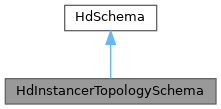
 Inheritance diagram for HdInstancerTopologySchema:
Classes | |
| class | Builder |
| Utility class for setting sparse sets of child data source fields to be filled as arguments into BuildRetained. More... | |
Public Member Functions | |
| HD_API VtArray< int > | ComputeInstanceIndicesForProto (SdfPath const &path) const |
Member accessor | |
| HD_API HdPathArrayDataSourceHandle | GetPrototypes () const |
| HD_API HdIntArrayVectorSchema | GetInstanceIndices () const |
| HD_API HdBoolArrayDataSourceHandle | GetMask () const |
| HD_API HdPathArrayDataSourceHandle | GetInstanceLocations () const |
| Public Member Functions inherited from HdSchema | |
| HdSchema (HdContainerDataSourceHandle container) | |
| HD_API HdContainerDataSourceHandle | GetContainer () const |
| Returns the container data source that this schema is interpreting. | |
| HD_API bool | IsDefined () const |
| operator bool () const | |
Returns true if this schema is applied on top of a non-null container. | |
Static Public Member Functions | |
Schema location | |
| static HD_API const TfToken & | GetSchemaToken () |
| Returns a token where the container representing this schema is found in a container by default. | |
| static HD_API const HdDataSourceLocator & | GetDefaultLocator () |
| Returns an HdDataSourceLocator (relative to the prim-level data source) where the container representing this schema is found by default. | |
Schema construction | |
| static HD_API HdContainerDataSourceHandle | BuildRetained (const HdPathArrayDataSourceHandle &prototypes, const HdVectorDataSourceHandle &instanceIndices, const HdBoolArrayDataSourceHandle &mask, const HdPathArrayDataSourceHandle &instanceLocations) |
Schema retrieval | |
| HdInstancerTopologySchema (HdContainerDataSourceHandle container) | |
| static HD_API HdInstancerTopologySchema | GetFromParent (const HdContainerDataSourceHandle &fromParentContainer) |
| Retrieves a container data source with the schema's default name token "instancerTopology" from the parent container and constructs a HdInstancerTopologySchema instance. | |
Additional Inherited Members | |
| Public Types inherited from HdSchema | |
| using | UnderlyingDataSource = HdContainerDataSource |
| Protected Member Functions inherited from HdSchema | |
| template<typename T > | |
| T::Handle | _GetTypedDataSource (TfToken name) const |
| Returns a datasource of the requested type for the given name: schema implementations can use this to ask for child containers, sampled values, vectors, etc. | |
| Protected Attributes inherited from HdSchema | |
| HdContainerDataSourceHandle | _container |
Since the instancing schema is complicated:
An instancer is a prim at a certain scenegraph location that causes other prims to be duplicated. The instancer can also hold instance-varying data like constant primvars or material relationships.
The important things an instancer has is:
1.) Instancer topology, describing how exactly the prims are duplicated;
2.) Instance-rate data, meaning data that varies per instance, such as primvars or material bindings.
If an instancer causes prims "/A" and "/B" to be duplicated, we encode that by setting prototypes = ["/A", "/B"]. Note that "/A" and "/B" can be subtrees, not direct gprims. instanceIndices encodes both multiplicity and position in arrays of instance-rate data, per prototype path; if instanceIndices = { [0,2], [1] }, then we draw /A twice (with instance primvar indices 0 and 2); and /B once (with instance primvar index 1). Mask is an auxiliary parameter that can be used to deactivate certain instances; mask = [true, true, false] would disable the second copy of "/A". An empty mask array is the same as all-true.
Scenes generally specify instancing in one of two ways:
1.) Explicit instancing: prim /Instancer wants to draw its subtree at an array of locations. This is a data expansion form.
2.) Implicit instancing: prims /X and /Y are marked as being identical, and scene load replaces them with a single prim and an instancer. This is a data coalescing form.
For implicit instancing, we want to know the original paths of /X and /Y, for doing things like resolving inheritance. This is encoded in the "instanceLocations" path, while the prototype prims (e.g. /_Prototype/Cube, the deduplicated version of /X/Cube and /Y/Cube) is encoded in the "prototypes" path.
For explicit instancing, the "instanceLocations" attribute is meaningless and should be left null.
Definition at line 92 of file instancerTopologySchema.h.
|
inline |
Definition at line 98 of file instancerTopologySchema.h.
|
static |
Builds a container data source which includes the provided child data sources. Parameters with nullptr values are excluded. This is a low-level interface. For cases in which it's desired to define the container with a sparse set of child fields, the Builder class is often more convenient and readable.
|
static |
Returns an HdDataSourceLocator (relative to the prim-level data source) where the container representing this schema is found by default.
|
static |
Retrieves a container data source with the schema's default name token "instancerTopology" from the parent container and constructs a HdInstancerTopologySchema instance.
Because the requested container data source may not exist, the result should be checked with IsDefined() or a bool comparison before use.
|
static |
Returns a token where the container representing this schema is found in a container by default.
 1.12.0