 |
|
|
|
Controls for shaping a light's emission. More...
#include <shapingAPI.h>
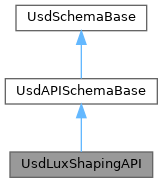
 Inheritance diagram for UsdLuxShapingAPI:
Public Member Functions | |
| UsdLuxShapingAPI (const UsdPrim &prim=UsdPrim()) | |
Construct a UsdLuxShapingAPI on UsdPrim prim . | |
| UsdLuxShapingAPI (const UsdSchemaBase &schemaObj) | |
Construct a UsdLuxShapingAPI on the prim held by schemaObj . | |
| virtual USDLUX_API | ~UsdLuxShapingAPI () |
| Destructor. | |
| USDLUX_API UsdAttribute | GetShapingFocusAttr () const |
| A control to shape the spread of light. | |
| USDLUX_API UsdAttribute | CreateShapingFocusAttr (VtValue const &defaultValue=VtValue(), bool writeSparsely=false) const |
| See GetShapingFocusAttr(), and also Create vs Get Property Methods for when to use Get vs Create. | |
| USDLUX_API UsdAttribute | GetShapingFocusTintAttr () const |
| Off-axis color tint. | |
| USDLUX_API UsdAttribute | CreateShapingFocusTintAttr (VtValue const &defaultValue=VtValue(), bool writeSparsely=false) const |
| See GetShapingFocusTintAttr(), and also Create vs Get Property Methods for when to use Get vs Create. | |
| USDLUX_API UsdAttribute | GetShapingConeAngleAttr () const |
| Angular limit off the primary axis to restrict the light spread, in degrees. | |
| USDLUX_API UsdAttribute | CreateShapingConeAngleAttr (VtValue const &defaultValue=VtValue(), bool writeSparsely=false) const |
| See GetShapingConeAngleAttr(), and also Create vs Get Property Methods for when to use Get vs Create. | |
| USDLUX_API UsdAttribute | GetShapingConeSoftnessAttr () const |
| Controls the cutoff softness for cone angle. | |
| USDLUX_API UsdAttribute | CreateShapingConeSoftnessAttr (VtValue const &defaultValue=VtValue(), bool writeSparsely=false) const |
| See GetShapingConeSoftnessAttr(), and also Create vs Get Property Methods for when to use Get vs Create. | |
| USDLUX_API UsdAttribute | GetShapingIesFileAttr () const |
| An IES (Illumination Engineering Society) light profile describing the angular distribution of light. | |
| USDLUX_API UsdAttribute | CreateShapingIesFileAttr (VtValue const &defaultValue=VtValue(), bool writeSparsely=false) const |
| See GetShapingIesFileAttr(), and also Create vs Get Property Methods for when to use Get vs Create. | |
| USDLUX_API UsdAttribute | GetShapingIesAngleScaleAttr () const |
| Rescales the angular distribution of the IES profile. | |
| USDLUX_API UsdAttribute | CreateShapingIesAngleScaleAttr (VtValue const &defaultValue=VtValue(), bool writeSparsely=false) const |
| See GetShapingIesAngleScaleAttr(), and also Create vs Get Property Methods for when to use Get vs Create. | |
| USDLUX_API UsdAttribute | GetShapingIesNormalizeAttr () const |
| Normalizes the IES profile so that it affects the shaping of the light while preserving the overall energy output. | |
| USDLUX_API UsdAttribute | CreateShapingIesNormalizeAttr (VtValue const &defaultValue=VtValue(), bool writeSparsely=false) const |
| See GetShapingIesNormalizeAttr(), and also Create vs Get Property Methods for when to use Get vs Create. | |
Conversion to and from UsdShadeConnectableAPI | |
| USDLUX_API | UsdLuxShapingAPI (const UsdShadeConnectableAPI &connectable) |
| Constructor that takes a ConnectableAPI object. | |
| USDLUX_API UsdShadeConnectableAPI | ConnectableAPI () const |
| Contructs and returns a UsdShadeConnectableAPI object with this shaping API prim. | |
Outputs API | |
Outputs represent a typed attribute on a shaping API whose value is computed externally. | |
| USDLUX_API UsdShadeOutput | CreateOutput (const TfToken &name, const SdfValueTypeName &typeName) |
| Create an output which can either have a value or can be connected. | |
| USDLUX_API UsdShadeOutput | GetOutput (const TfToken &name) const |
| Return the requested output if it exists. | |
| USDLUX_API std::vector< UsdShadeOutput > | GetOutputs (bool onlyAuthored=true) const |
| Outputs are represented by attributes in the "outputs:" namespace. | |
Inputs API | |
Inputs are connectable attribute with a typed value. Shaping API parameters are encoded as inputs. | |
| USDLUX_API UsdShadeInput | CreateInput (const TfToken &name, const SdfValueTypeName &typeName) |
| Create an input which can either have a value or can be connected. | |
| USDLUX_API UsdShadeInput | GetInput (const TfToken &name) const |
| Return the requested input if it exists. | |
| USDLUX_API std::vector< UsdShadeInput > | GetInputs (bool onlyAuthored=true) const |
| Inputs are represented by attributes in the "inputs:" namespace. | |
| Public Member Functions inherited from UsdAPISchemaBase | |
| UsdAPISchemaBase (const UsdPrim &prim=UsdPrim()) | |
Construct a UsdAPISchemaBase on UsdPrim prim . | |
| UsdAPISchemaBase (const UsdSchemaBase &schemaObj) | |
Construct a UsdAPISchemaBase on the prim held by schemaObj . | |
| virtual USD_API | ~UsdAPISchemaBase ()=0 |
| Destructor. | |
| Public Member Functions inherited from UsdSchemaBase | |
| bool | IsConcrete () const |
| Returns whether or not this class corresponds to a concrete instantiable prim type in scene description. | |
| bool | IsTyped () const |
| Returns whether or not this class inherits from UsdTyped. | |
| bool | IsAPISchema () const |
| Returns whether this is an API schema or not. | |
| bool | IsAppliedAPISchema () const |
| Returns whether this is an applied API schema or not. | |
| bool | IsMultipleApplyAPISchema () const |
| Returns whether this is an applied API schema or not. | |
| UsdSchemaKind | GetSchemaKind () const |
| Returns the kind of schema this class is. | |
| USD_API | UsdSchemaBase (const UsdPrim &prim=UsdPrim()) |
Construct and store prim as the held prim. | |
| USD_API | UsdSchemaBase (const UsdSchemaBase &otherSchema) |
Construct and store for the same prim held by otherSchema. | |
| virtual USD_API | ~UsdSchemaBase () |
| Destructor. | |
| UsdPrim | GetPrim () const |
| Return this schema object's held prim. | |
| SdfPath | GetPath () const |
| Shorthand for GetPrim()->GetPath(). | |
| USD_API const UsdPrimDefinition * | GetSchemaClassPrimDefinition () const |
| Return the prim definition associated with this schema instance if one exists, otherwise return null. | |
| USD_API | operator bool () const |
| Return true if this schema object is compatible with its held prim, false otherwise. | |
Static Public Member Functions | |
| static USDLUX_API const TfTokenVector & | GetSchemaAttributeNames (bool includeInherited=true) |
| Return a vector of names of all pre-declared attributes for this schema class and all its ancestor classes. | |
| static USDLUX_API UsdLuxShapingAPI | Get (const UsdStagePtr &stage, const SdfPath &path) |
Return a UsdLuxShapingAPI holding the prim adhering to this schema at path on stage. | |
| static USDLUX_API bool | CanApply (const UsdPrim &prim, std::string *whyNot=nullptr) |
Returns true if this single-apply API schema can be applied to the given prim. | |
| static USDLUX_API UsdLuxShapingAPI | Apply (const UsdPrim &prim) |
Applies this single-apply API schema to the given prim. | |
| Static Public Member Functions inherited from UsdAPISchemaBase | |
| static USD_API const TfTokenVector & | GetSchemaAttributeNames (bool includeInherited=true) |
| Return a vector of names of all pre-declared attributes for this schema class and all its ancestor classes. | |
| Static Public Member Functions inherited from UsdSchemaBase | |
| static const TfTokenVector & | GetSchemaAttributeNames (bool includeInherited=true) |
Static Public Attributes | |
| static const UsdSchemaKind | schemaKind = UsdSchemaKind::SingleApplyAPI |
| Compile time constant representing what kind of schema this class is. | |
| Static Public Attributes inherited from UsdAPISchemaBase | |
| static const UsdSchemaKind | schemaKind = UsdSchemaKind::AbstractBase |
| Compile time constant representing what kind of schema this class is. | |
| Static Public Attributes inherited from UsdSchemaBase | |
| static const UsdSchemaKind | schemaKind = UsdSchemaKind::AbstractBase |
| Compile time constant representing what kind of schema this class is. | |
Protected Member Functions | |
| USDLUX_API UsdSchemaKind | _GetSchemaKind () const override |
| Returns the kind of schema this class belongs to. | |
| Protected Member Functions inherited from UsdAPISchemaBase | |
| UsdAPISchemaBase (const UsdPrim &prim, const TfToken &instanceName) | |
Construct a multiple-apply UsdAPISchemaBase on UsdPrim prim with the specified instanceName. | |
| UsdAPISchemaBase (const UsdSchemaBase &schemaObj, const TfToken &instanceName) | |
Construct a multiple-apply UsdAPISchemaBase on the prim held by schemaObj with the given instanceName. | |
| const TfToken & | _GetInstanceName () const |
| Returns the instance name of the API schema object belonging to a multiple-apply API schema. | |
| USD_API bool | _IsCompatible () const override |
| Check whether this APISchema object is valid for the currently held prim. | |
| Protected Member Functions inherited from UsdSchemaBase | |
| virtual UsdSchemaKind | _GetSchemaType () const |
| const TfType & | _GetType () const |
| USD_API UsdAttribute | _CreateAttr (TfToken const &attrName, SdfValueTypeName const &typeName, bool custom, SdfVariability variability, VtValue const &defaultValue, bool writeSparsely) const |
Friends | |
| class | UsdSchemaRegistry |
Additional Inherited Members | |
| Static Protected Member Functions inherited from UsdAPISchemaBase | |
| static USD_API TfTokenVector | _GetMultipleApplyInstanceNames (const UsdPrim &prim, const TfType &schemaType) |
| Returns a vector of names of API schema objects belonging to a multiple-apply API schema applied to a given prim. | |
Controls for shaping a light's emission.
Definition at line 43 of file shapingAPI.h.
|
inlineexplicit |
Construct a UsdLuxShapingAPI on UsdPrim prim .
Equivalent to UsdLuxShapingAPI::Get(prim.GetStage(), prim.GetPath()) for a valid prim, but will not immediately throw an error for an invalid prim
Definition at line 55 of file shapingAPI.h.
|
inlineexplicit |
Construct a UsdLuxShapingAPI on the prim held by schemaObj .
Should be preferred over UsdLuxShapingAPI(schemaObj.GetPrim()), as it preserves SchemaBase state.
Definition at line 63 of file shapingAPI.h.
|
virtual |
Destructor.
| USDLUX_API UsdLuxShapingAPI | ( | const UsdShadeConnectableAPI & | connectable | ) |
Constructor that takes a ConnectableAPI object.
Allow implicit conversion of UsdShadeConnectableAPI to UsdLuxShapingAPI.
|
overrideprotectedvirtual |
Returns the kind of schema this class belongs to.
Reimplemented from UsdAPISchemaBase.
|
static |
Applies this single-apply API schema to the given prim.
This information is stored by adding "ShapingAPI" to the token-valued, listOp metadata apiSchemas on the prim.
|
static |
Returns true if this single-apply API schema can be applied to the given prim.
If this schema can not be a applied to the prim, this returns false and, if provided, populates whyNot with the reason it can not be applied.
Note that if CanApply returns false, that does not necessarily imply that calling Apply will fail. Callers are expected to call CanApply before calling Apply if they want to ensure that it is valid to apply a schema.
| USDLUX_API UsdShadeConnectableAPI ConnectableAPI | ( | ) | const |
Contructs and returns a UsdShadeConnectableAPI object with this shaping API prim.
Note that a valid UsdLuxShapingAPI will only return a valid UsdShadeConnectableAPI if the its prim's Typed schema type is actually connectable.
| USDLUX_API UsdShadeInput CreateInput | ( | const TfToken & | name, |
| const SdfValueTypeName & | typeName ) |
Create an input which can either have a value or can be connected.
The attribute representing the input is created in the "inputs:" namespace. Inputs on shaping API are connectable.
| USDLUX_API UsdShadeOutput CreateOutput | ( | const TfToken & | name, |
| const SdfValueTypeName & | typeName ) |
Create an output which can either have a value or can be connected.
The attribute representing the output is created in the "outputs:" namespace. Outputs on a shaping API cannot be connected, as their value is assumed to be computed externally.
| USDLUX_API UsdAttribute CreateShapingConeAngleAttr | ( | VtValue const & | defaultValue = VtValue(), |
| bool | writeSparsely = false ) const |
See GetShapingConeAngleAttr(), and also Create vs Get Property Methods for when to use Get vs Create.
If specified, author defaultValue as the attribute's default, sparsely (when it makes sense to do so) if writeSparsely is true - the default for writeSparsely is false.
| USDLUX_API UsdAttribute CreateShapingConeSoftnessAttr | ( | VtValue const & | defaultValue = VtValue(), |
| bool | writeSparsely = false ) const |
See GetShapingConeSoftnessAttr(), and also Create vs Get Property Methods for when to use Get vs Create.
If specified, author defaultValue as the attribute's default, sparsely (when it makes sense to do so) if writeSparsely is true - the default for writeSparsely is false.
| USDLUX_API UsdAttribute CreateShapingFocusAttr | ( | VtValue const & | defaultValue = VtValue(), |
| bool | writeSparsely = false ) const |
See GetShapingFocusAttr(), and also Create vs Get Property Methods for when to use Get vs Create.
If specified, author defaultValue as the attribute's default, sparsely (when it makes sense to do so) if writeSparsely is true - the default for writeSparsely is false.
| USDLUX_API UsdAttribute CreateShapingFocusTintAttr | ( | VtValue const & | defaultValue = VtValue(), |
| bool | writeSparsely = false ) const |
See GetShapingFocusTintAttr(), and also Create vs Get Property Methods for when to use Get vs Create.
If specified, author defaultValue as the attribute's default, sparsely (when it makes sense to do so) if writeSparsely is true - the default for writeSparsely is false.
| USDLUX_API UsdAttribute CreateShapingIesAngleScaleAttr | ( | VtValue const & | defaultValue = VtValue(), |
| bool | writeSparsely = false ) const |
See GetShapingIesAngleScaleAttr(), and also Create vs Get Property Methods for when to use Get vs Create.
If specified, author defaultValue as the attribute's default, sparsely (when it makes sense to do so) if writeSparsely is true - the default for writeSparsely is false.
| USDLUX_API UsdAttribute CreateShapingIesFileAttr | ( | VtValue const & | defaultValue = VtValue(), |
| bool | writeSparsely = false ) const |
See GetShapingIesFileAttr(), and also Create vs Get Property Methods for when to use Get vs Create.
If specified, author defaultValue as the attribute's default, sparsely (when it makes sense to do so) if writeSparsely is true - the default for writeSparsely is false.
| USDLUX_API UsdAttribute CreateShapingIesNormalizeAttr | ( | VtValue const & | defaultValue = VtValue(), |
| bool | writeSparsely = false ) const |
See GetShapingIesNormalizeAttr(), and also Create vs Get Property Methods for when to use Get vs Create.
If specified, author defaultValue as the attribute's default, sparsely (when it makes sense to do so) if writeSparsely is true - the default for writeSparsely is false.
|
static |
Return a UsdLuxShapingAPI holding the prim adhering to this schema at path on stage.
If no prim exists at path on stage, or if the prim at that path does not adhere to this schema, return an invalid schema object. This is shorthand for the following:
| USDLUX_API UsdShadeInput GetInput | ( | const TfToken & | name | ) | const |
Return the requested input if it exists.
| USDLUX_API std::vector< UsdShadeInput > GetInputs | ( | bool | onlyAuthored = true | ) | const |
Inputs are represented by attributes in the "inputs:" namespace.
If onlyAuthored is true (the default), then only return authored attributes; otherwise, this also returns un-authored builtins.
| USDLUX_API UsdShadeOutput GetOutput | ( | const TfToken & | name | ) | const |
Return the requested output if it exists.
| USDLUX_API std::vector< UsdShadeOutput > GetOutputs | ( | bool | onlyAuthored = true | ) | const |
Outputs are represented by attributes in the "outputs:" namespace.
If onlyAuthored is true (the default), then only return authored attributes; otherwise, this also returns un-authored builtins.
|
static |
Return a vector of names of all pre-declared attributes for this schema class and all its ancestor classes.
Does not include attributes that may be authored by custom/extended methods of the schemas involved.
| USDLUX_API UsdAttribute GetShapingConeAngleAttr | ( | ) | const |
Angular limit off the primary axis to restrict the light spread, in degrees.
Light emissions at angles off the primary axis greater than this are guaranteed to be zero, i.e.:
For angles < coneAngle, see the documentation for shaping:cone:softness. However, at the default of coneSoftness = 0, the luminance is unaltered if emissionOffAxisAngle <= coneAngle, so the coneAngle functions as a hard binary "off" toggle for all angles > coneAngle.
| Declaration | float inputs:shaping:cone:angle = 90 |
| C++ Type | float |
| Usd Type | SdfValueTypeNames->Float |
| USDLUX_API UsdAttribute GetShapingConeSoftnessAttr | ( | ) | const |
Controls the cutoff softness for cone angle.
At the default of coneSoftness = 0, the luminance is unaltered if emissionOffAxisAngle <= coneAngle, and 0 if emissionOffAxisAngle > coneAngle, so in this situation the coneAngle functions as a hard binary "off" toggle for all angles > coneAngle.
For coneSoftness in the range (0, 1], it defines the proportion of the non-cutoff angles over which the luminance is smoothly interpolated from 0 to 1. Mathematically:
Values outside of the [0, 1] range are clamped to the range.
| Declaration | float inputs:shaping:cone:softness = 0 |
| C++ Type | float |
| Usd Type | SdfValueTypeNames->Float |
| USDLUX_API UsdAttribute GetShapingFocusAttr | ( | ) | const |
A control to shape the spread of light.
Higher focus values pull light towards the center and narrow the spread.
This is implemented as a multiplication with the absolute value of the dot product between the light's primary axis and the emission direction, raised to the power focus. See inputs:shaping:focusTint for the complete formula, but if we assume a default focusTint of pure black, then that formula simplifies to:
Values < 0 are ignored.
Note that the absolute value in the formula above means that sphere and cylinder lights will emit "behind" the light as well as in front. If it is desired that the light emits forward only, this can be achieved by setting the inputs:shaping:coneAngle to 90 degrees or less.
| Declaration | float inputs:shaping:focus = 0 |
| C++ Type | float |
| Usd Type | SdfValueTypeNames->Float |
| USDLUX_API UsdAttribute GetShapingFocusTintAttr | ( | ) | const |
Off-axis color tint.
This tints the emission in the falloff region. The default tint is black.
This is implemented as a linear interpolation between focusTint and white, by the factor computed from the focus attribute, in other words:
Note that this implies that a focusTint of pure white will disable focus.
Note that the absolute value in the formula above means that sphere and cylinder lights will emit "behind" the light as well as in front. If it is desired that the light emits forward only, this can be achieved by setting the inputs:shaping:coneAngle to 90 degrees or less.
| Declaration | color3f inputs:shaping:focusTint = (0, 0, 0) |
| C++ Type | GfVec3f |
| Usd Type | SdfValueTypeNames->Color3f |
| USDLUX_API UsdAttribute GetShapingIesAngleScaleAttr | ( | ) | const |
Rescales the angular distribution of the IES profile.
Applies a scaling factor to the latitudinal theta/vertical polar coordinate before sampling the IES profile, to shift the samples more toward the "top" or "bottom" of the profile. The scaling origin varies depending on whether angleScale is positive or negative. If it is positive, the scaling origin is theta = 0. If it is negative, the scaling origin is theta = pi (180 degrees). Values where |angleScale| < 1 will "shrink" the angular range in which the iesProfile is applied, while values where |angleScale| > 1 will "grow" the angular range to which the iesProfile is mapped.
If 𝛳light is the latitudinal theta polar coordinate of the emission direction in the light's local space, and 𝛳ies is the value that will be used when actually sampling the profile, then the exact formula is:
Usage guidelines for artists / lighting TDs:
If you have an IES profile for a spotlight aimed "down":
For example, if the original IES profile is a downward spotlight with a total cone angle of 60°, then angleScale = .5 will narrow it to have a cone angle of 30°, and an angleScale of 1.5 will broaden it to have a cone angle of 90°.
If you have an IES profile for a spotlight aimed "up":
For example, if the original IES profile is an upward spotlight with a total cone angle of 60°, then angleScale = -.5 will narrow it to have a cone angle of 30°, and an angleScale of -1.5 will broaden it to have a cone angle of 90°.
If you have an IES profile that's isn't clearly "aimed" in a single direction, OR it's aimed in a direction other than straight up or down:
If you violate the above rules (i.e., use a negative angleScale for a spotlight aimed down), then angleScale will still alter the vertical- angle mapping, but in more non-intuitive ways (i.e., broadening / narrowing may seem inverted, and the IES profile may seem to "translate" through the vertical angles, rather than uniformly scale).
| Declaration | float inputs:shaping:ies:angleScale = 0 |
| C++ Type | float |
| Usd Type | SdfValueTypeNames->Float |
| USDLUX_API UsdAttribute GetShapingIesFileAttr | ( | ) | const |
An IES (Illumination Engineering Society) light profile describing the angular distribution of light.
For full details on the .ies file format, see the full specification, ANSI/IES LM-63-19:
The luminous intensity values in the IES profile are sampled using the emission direction in the light's local space (after a possible transformation by a non-zero shaping:ies:angleScale, see below). The sampled value is then potentially normalized by the overall power of the profile if shaping:ies:normalize is enabled, and then used as a scaling factor on the returned luminance:
See inputs:shaping:ies:angleScale for a description of applyAngleScale, and inputs:shaping:ies:normalize for how iesProfilePower is calculated.
| Declaration | asset inputs:shaping:ies:file |
| C++ Type | SdfAssetPath |
| Usd Type | SdfValueTypeNames->Asset |
| USDLUX_API UsdAttribute GetShapingIesNormalizeAttr | ( | ) | const |
Normalizes the IES profile so that it affects the shaping of the light while preserving the overall energy output.
The sampled luminous intensity is scaled by the overall power of the IES profile if this is on, where the total power is calculated by integrating the luminous intensity over all solid angle patches defined in the profile.
| Declaration | bool inputs:shaping:ies:normalize = 0 |
| C++ Type | bool |
| Usd Type | SdfValueTypeNames->Bool |
|
friend |
Definition at line 141 of file shapingAPI.h.
|
static |
Compile time constant representing what kind of schema this class is.
Definition at line 49 of file shapingAPI.h.
 1.12.0