|
Enable a concrete base class for use with TfRefPtr.
More...
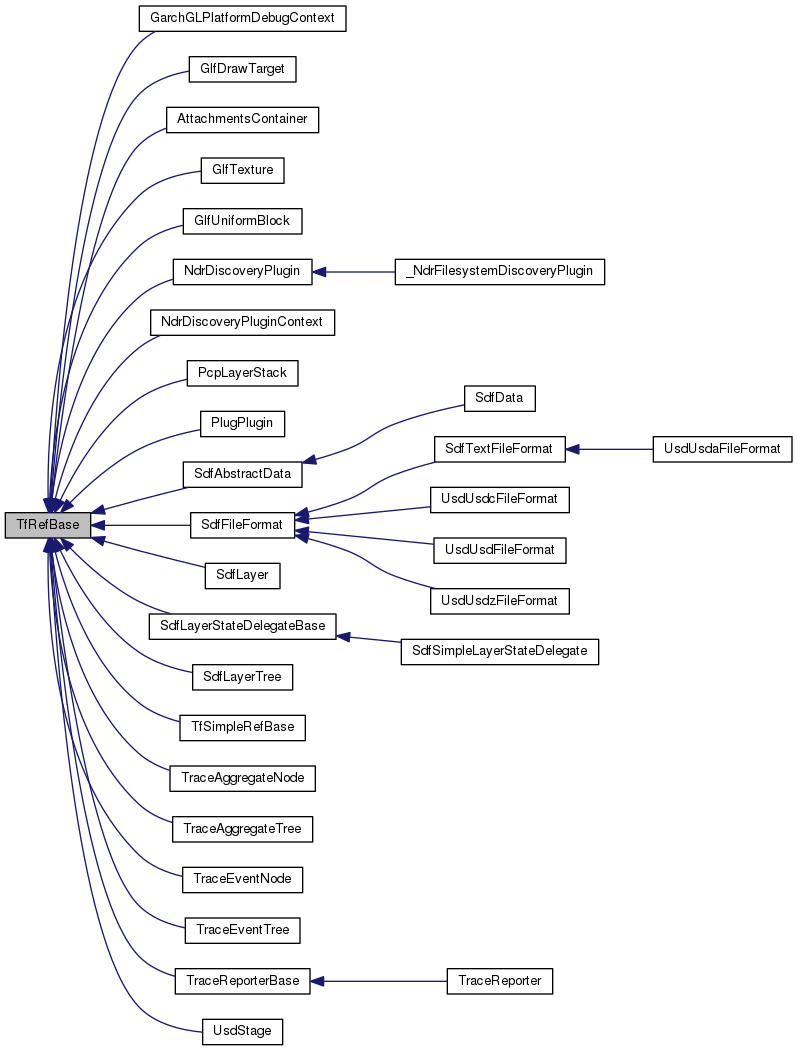
 Inheritance diagram for TfRefBase:
Public Types | |
| typedef void(* | UniqueChangedFuncPtr )(TfRefBase const *, bool) |
Public Member Functions | |
| size_t | GetCurrentCount () const |
| Return the current reference count of this object. More... | |
| bool | IsUnique () const |
Return true if only one TfRefPtr points to this object. More... | |
| const TfRefCount & | GetRefCount () const |
| void | SetShouldInvokeUniqueChangedListener (bool shouldCall) |
Static Public Member Functions | |
| static TF_API void | SetUniqueChangedListener (UniqueChangedListener listener) |
Friends | |
| template<typename T > | |
| class | TfRefPtr |
| template<typename T > | |
| TfRefPtr< T > | TfCreateRefPtrFromProtectedWeakPtr (TfWeakPtr< T > const &) |
| Thread-safe creation of a Tf ref pointer from a Tf weak pointer. More... | |
Enable a concrete base class for use with TfRefPtr.
You should be familiar with the TfRefPtr type before reading further.
A class (but not an interface class) is enabled for reference counting via the TfRefPtr type by publicly deriving from TfRefBase.
For example,
The class Simple can now only be manipulated in terms of a TfRefPtr<Simple>.
To disable the cost of the "unique changed" system, derive from TfSimpleRefBase instead.
|
inline |
|
inline |
Thread-safe creation of a Tf ref pointer from a Tf weak pointer.
This is thread-safe in the sense that the result will be either a ref pointer to a live object with non-zero ref-count, or a NULL ref pointer. However, this depends on the client to provide a guarantee to protect the pointed-to object.
Specifically, the caller must guarantee that the TfRefBase part of the pointed-to object is not destroyed during this call. It is fine if the destruction process for the object begins (due to the ref-count going to zero as another thread drops the last ref) as long as the TfRefBase portion is not destroyed. If object destruction begins because the ref-count goes to zero before this call completes, this function will reliably return a NULL ref pointer.
Note that this is not a general mechanism for safely converting weak pointers to ref pointers, because it relies on the type T to provide the above guarantee.
 1.8.5
1.8.5