|
Manage a single instance of an object. More...
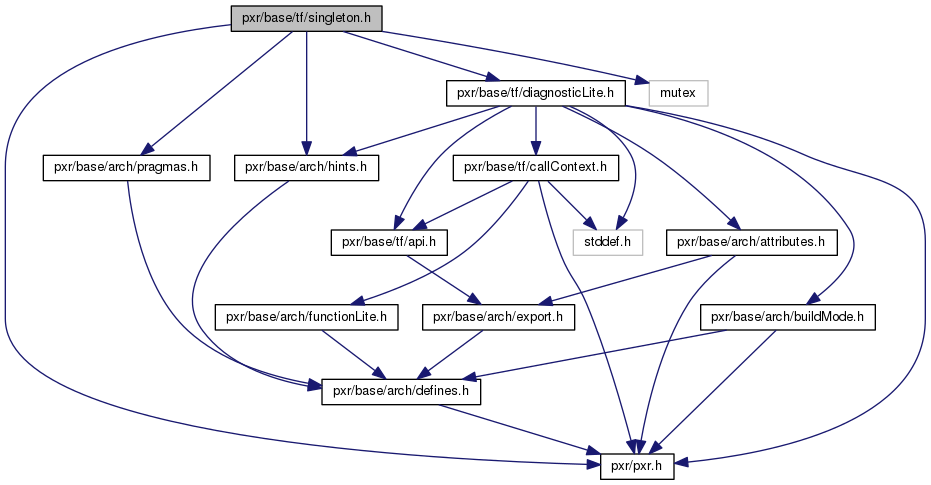
 Include dependency graph for singleton.h: This graph shows which files directly or indirectly include this file:
Go to the source code of this file.
Classes | |
| class | TfSingleton< T > |
| Manage a single instance of an object (see. More... | |
Manage a single instance of an object.
Many classes (for example, registries) should have only a single, globally available instance that is created as needed on demand. This is a classic design pattern known as a singleton. Additionally, creation of this class (though not access to it per se) must be made threadsafe.
There are two possibilities in creating a singleton: you can create a class all of whose member functions and variables are static, and let users access this class. Unfortunately, instantiating the static variables of this class is prone to difficulty; more importantly, should you change your mind and wish to allow multiple instances of the class, much rewriting follows.
A better solution is to define the class with regular members and variables, and then permit only a single instance of the class to exist. This is the philosophy embodied by the TfSingleton template. It takes care of both multithreaded initialization and initialization before main; the cost of this is quite low (a single boolean comparison to access the instanced object after initial creation). The TfSingleton template works in conjunction with a macro in the source file TF_INSTANTIATE_SINGLETON(), which is itself defined by including the file "pxr/base/tf/instantiateSingleton.h".
The typical use of TfSingleton is as follows:
The constructor and destructor are declared private, and the singleton object will typically derive off of boost::noncopyable to prevent copying. Note that singleton objects quite commonly also make use of TfRegistryManager to acquire the data they need throughout a program.
The friend class TfSingleton<Registry> is the only class allowed to create an instance of a Registry. The helper function Registry::GetInstance() is for convenience only; one can just as well call the longer TfSingleton<Registry>::GetInstance() to obtain a reference to the sole instance of the registry.
Definition in file singleton.h.
 1.8.5
1.8.5