DistantLight
An intrinsic light that provides light from
a distant source, along the -Z axis. Also known as a “directional light”.
Typically used for distant, broad sources of light, like sunlight, where light
rays affect the entire scene and are roughly parallel (depending on
inputs:angle).
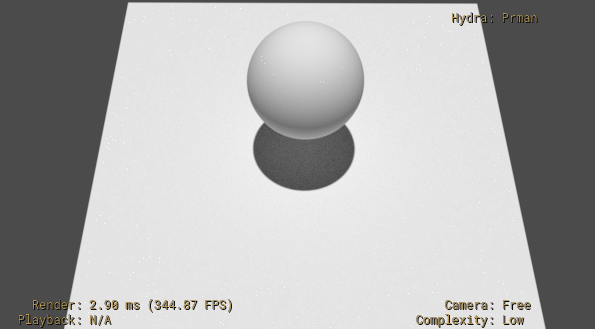
The following example uses a DistantLight with a increased inputs:angle of
1.0 (noticeably broadening the light spread, but softening the shadow), and
reduces the intensity from the default 50000 to 10000.
#usda 1.0
(
    upAxis = "Y"
)

def Scope "Lights"
{
    def DistantLight "Light1"
    {
        float inputs:angle = 1.0
        float inputs:intensity = 10000
    }
}

def Xform "TestGeom"
{
    def Sphere "Sphere1"
    {
        color3f[] primvars:displayColor = [(1, 1, 1)] (
            interpolation = "constant"
        )
        double3 xformOp:translate = (0, 0, -2)
        uniform token[] xformOpOrder = ["xformOp:translate"]
    }

    def Cube "Cube"
    {
        color3f[] primvars:displayColor = [(1, 1, 1)] (
            interpolation = "constant"
        )
        double size = 8
        double3 xformOp:translate = (0, 0, -8)
        uniform token[] xformOpOrder = ["xformOp:translate"]
    }
}
Example RenderMan output for this layer:
Properties
inputs:angle
USD type: float
Fallback value: 0.5299999713897705
Sets the angular diameter of the DistantLight in degrees. The fallback value is 0.53, which approximates the 0.53 degree angular size of the Sun as seen from Earth.
Higher values soften the shadow edges (light rays become less parallel) while lower values make it sharper. Larger values increase shadow softness by increasing the angle of its light.
This value is assumed to be in the range 0 <= angle < 360, and will be clipped
to this range. Note that this implies that we can have a distant light emitting
from more than a hemispherical area of light if angle > 180. While this is
valid, it is possible that for large angles a DomeLight may provide better
performance.
Increasing this parameter also increases the amount of light in the scene and you may need to reduce the light intensity/exposure to compensate.
inputs:intensity
USD type: float
Fallback value: 50000.0
Scales the brightness of the light linearly. The fallback value of 50000 provides a high intensity to approximate sunlight.
Expresses the “base”, unmultiplied luminance emitted (L) of the light, in nits (cd∕m²):
Normatively, the lights’ emission is in units of spectral radiance
normalized such that a directly visible light with intensity 1 and
exposure 0 normally incident upon the sensor plane will generate a
pixel value of [1, 1, 1] in an RGB renderer, and thus have a luminance
of 1 nit. A light with intensity 2 and exposure 0 would therefore
have a luminance of 2 nits.
light:shaderId
USD type: token
Fallback value: DistantLight
The shader ID for a DistantLight. USD will also register a Sdr shader node with a “DistantLight” identifier and the shading system “USD” to correspond to the light’s inputs.
Inherited Properties (Xformable)
xformOpOrder
USD type: token[]
Inherited Properties (Imageable)
proxyPrim
USD type: rel (relationship)
purpose
USD type: token
Fallback value: default
visibility
USD type: token
Fallback value: inherited